How to coach intuitive learning.
You have a very ordinary capacity to tap into the unseen.

Untapped
The basic premise of what I teach is this:
You have access to far more information than you have been conditioned to believe is possible.
Tapping into this capacity creates a paradigm shift in how we learn, solve problems, and understand each other.
It’s up to individual visionary parents and educators to adopt these practices because we can’t wait for the system to wake up.
Today is the first of many stories of what’s possible.
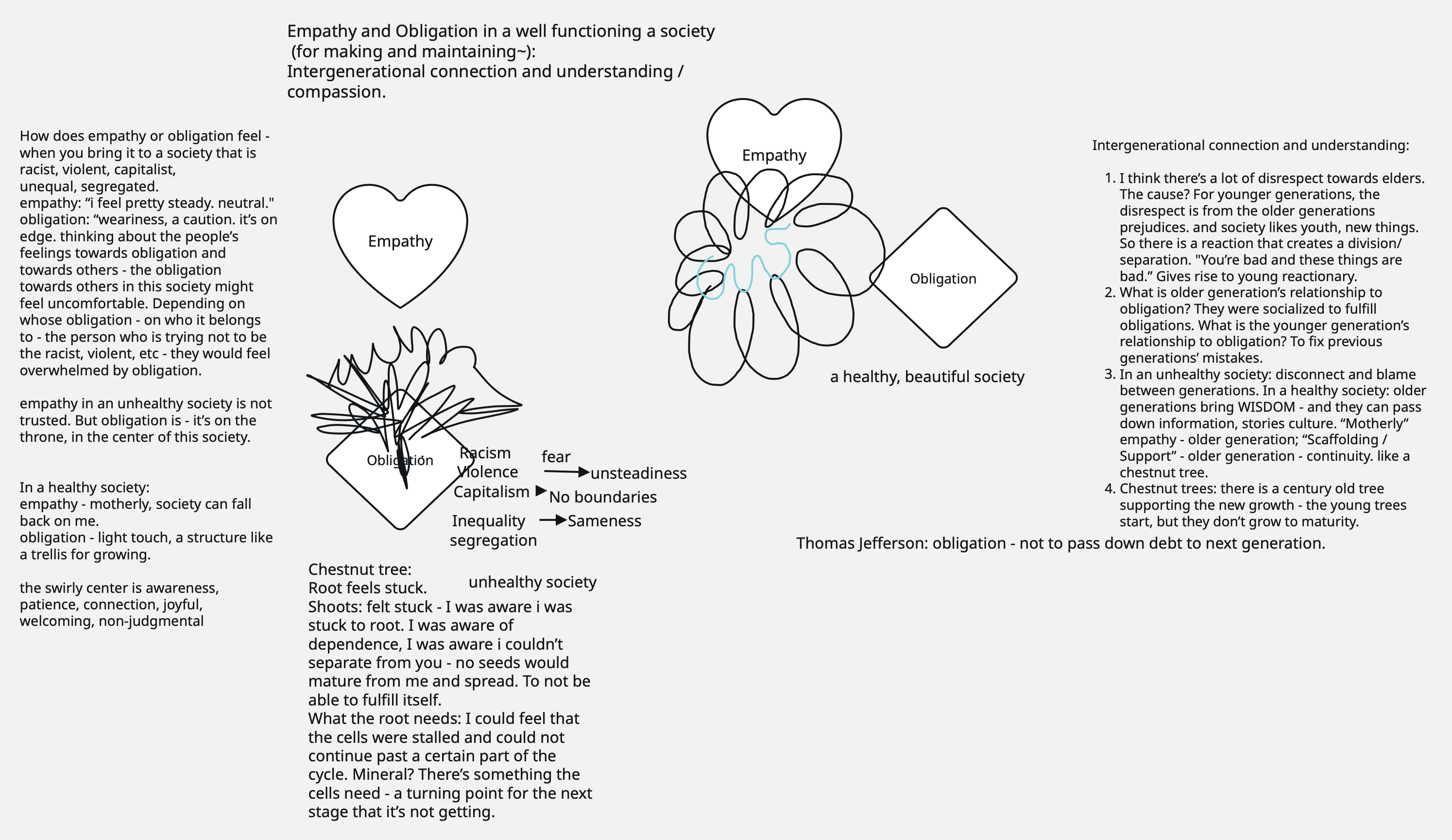
Mapping and sensing the question: What is the role of empathy and obligation in a well-functioning society?
Tapping into the unseen for a research paper.
In a recent coaching session, I helped a teen working on a research paper for a first-year writing course at her community college. The question her class had been given was, “What is the role of empathy and obligation in a well-functioning society?” For her research, she was provided two texts and asked to choose two additional.
I helped her map out her ideas and then sense into them. Specifically, she sensed into empathy and obligation in an unhealthy society, and then in a healthy one. She noticed that in an unhealthy society, obligation was at the center and empathy was at the perimeter. She said, “empathy is not trusted, but obligation feels like it’s on a throne.” If you look at the map, the unhealthy society is on the left.
In the healthy society, when she sensed into the elements of the system, empathy felt motherly. Empathy said, “Society can fall back on me.” She described obligation as having a light touch, like a trellis for growing plants. And she noticed that there was something else - she felt immediately that a third element was in the center. She imagined it to be a swirly center. When she went to that third element, she said, “awareness, patience, connection, not judgmental, joyful, welcoming.”
This became her thesis: empathy and obligation require a third element of awareness for a well-functioning society. She used this lens to re-examine the papers and wrote her research paper with this new perspective. She found, indeed, that each of the articles she read included an element she could identify as awareness.
This is a neurodiverse student who struggles with writing, feeling like her words get jammed up, and she can’t express herself. She still needed some help organizing her thoughts, but her writing flowed much more easily, especially with the help that I provided in transcribing her words as I coached her. And, of course, her original thinking was outstanding! She got an A.
If you look at the map, you’ll see that what she discovered was much more than just the thesis for her paper. For example, she studies permaculture, so at one point, we chose the American Chestnut tree as an inquiry about a healthy ecosystem. American Chestnuts suffer from a blight that prevents them from maturing to seed. You can see how this process can be a starting point for questions that have no known answers.
You can do this, too.
Here are some resources for you.
Check out Using Intuition to Understand People Better - it’s free on my YouTube Channel.
Get a Coaching Session with me. I can coach you through your own Sensethinking Inquiry about a subject you care about, or teach you how to do it with your children or students. I’ve got LOTS of techniques for different ages and contexts.
Keep an eye on this page for my New Course: Remembering Lost Ancestral Knowledge. This will be a mind-blowing, heart-opening experience in which you will take a deep dive to activate your sensing and intuition to explore ancestral knowledge that you didn’t think was possible to know. I am co-teaching this with artist Lori Wells and will share more about this in my next post.
And if this intrigues you, but you’ve got questions, drop a comment below. I love nothing more than talking about what’s possible!